
Video GEO: How to Optimize Your Brand Films for AI Answer Engines
The definitive masterclass on Generative Engine Optimization. Discover why traditional SEO is dying, how AI overviews are stealing your traffic, and why high-fidelity cinematic video is the ultimate antidote.
Executive Summary
Marketing directors are facing an unprecedented crisis. The advent of Google’s SGE (Search Generative Experience), ChatGPT, Perplexity, and other AI “Answer Engines” has ushered in the Zero-Click Era. Traditional text-based SEO, which brands have spent millions building, is being scraped and summarized by AI, preventing users from ever clicking through to the source website. Traffic is plummeting, and lead pipelines are drying up. However, there is a fundamental flaw in AI: it cannot scrape a cinematic experience. In 2026, GEO (Generative Engine Optimization) requires shifting your budget from easily-stolen text articles to un-stealable, high-fidelity video assets. This comprehensive, 4,000-word masterguide by 7 Hills Productions details exactly how to architect, produce, and technically optimize your brand videos so that AI engines prioritize your business as the ultimate authority in your sector.
Chapter 1: The Zero-Click Panic: The Death of Traditional SEO
If you are a CMO, Marketing Director, or Head of Digital, you have likely looked at your organic traffic analytics recently and felt a cold sweat. For the past decade, the playbook was simple: write a 2,000-word blog post optimized for a specific keyword, build backlinks, rank on page one of Google, and harvest the inbound traffic. Entire B2B marketing departments in hubs like Irvine and Silicon Valley were built around this exact inbound methodology.
That era is officially dead. The cause of death is the Large Language Model (LLM).
When a user searches for “Best B2B accounting software integration” today, they do not see a list of blue links leading to your carefully crafted blog post. Instead, Google’s AI Overview, or engines like Perplexity, instantly scrape the top 100 articles on the internet, synthesize the information, and provide a perfectly formatted, direct answer right on the search page. The user gets what they need and leaves. They never click your link. They never see your brand. They never enter your funnel.
This is the Zero-Click Crisis. If your brand relies solely on text to communicate value, you are effectively training the AI to replace you. The AI eats your text, digests your insights, and presents it to the user without giving you the credit. To survive, you must pivot to a medium that the AI cannot synthesize into a text summary: High-fidelity, emotionally resonant, cinematic video.
Chapter 2: Enter GEO (Generative Engine Optimization)
If SEO is the process of optimizing for standard search algorithms, GEO (Generative Engine Optimization) is the practice of optimizing your brand to be cited, recommended, and surfaced by Artificial Intelligence models. You are no longer trying to rank for a keyword; you are trying to be recognized as an authoritative “Entity” within an LLM’s neural network.
How LLMs Decide Who to Recommend
When someone asks ChatGPT, “Who is the best high-end video production company in Orange County?”, the AI uses a process called RAG (Retrieval-Augmented Generation). It looks for three primary signals to construct its answer:
- Information Gain: Does your content offer unique insights, data, or perspectives that cannot be found on Wikipedia or standard competitor sites? Generative AI penalizes copycats and rewards original thought.
- Entity Association: Is your brand consistently mentioned alongside high-authority terms? (e.g., 7 Hills Productions is consistently associated with ARRI cameras, Porsche, L’Oreal, and Irvine corporate hubs).
- E-E-A-T (Experience, Expertise, Authoritativeness, Trustworthiness): AI models are deeply programmed to look for verifiable human experience. They prioritize content that proves a real human actually did the thing they are talking about.
Text alone is failing the E-E-A-T test because AI can fake text. AI can write a blog post claiming “20 years of experience.” Therefore, AI answer engines are increasingly relying on rich media—specifically video—as the ultimate proof of human experience. If you have a video of your CEO walking through your manufacturing plant, that is an un-fakeable signal of authority.
Chapter 3: Why Video is the Ultimate Antidote to AI Traffic Loss
An AI can summarize your 3,000-word whitepaper into a bulleted list in 1.4 seconds. But an AI cannot summarize the experience of watching a beautifully crafted brand film. It cannot summarize the feeling of trust a prospect gets when they look into the eyes of your founder. It cannot synthesize the prestige conveyed by cinematic lighting, anamorphic lens flares, and a bespoke musical score.
The Un-Stealable Experience
Because video relies on sensory input—visual fidelity, emotional pacing, auditory cues, and human mirror neurons—it creates an “Information Gap” that text cannot fill. When an AI Answer Engine detects that a webpage contains a highly-rated, highly-relevant video, it knows it cannot simply scrape the text and satisfy the user. The AI is forced to provide a link to the video, driving the user out of the AI interface and directly onto your website or your YouTube channel.
Visual Proof and Cognitive Ease
In B2B marketing, the buying cycle is notoriously complex. Prospects are overwhelmed with data. Cinematic video provides “Cognitive Ease.” It takes complex, abstract concepts (like software infrastructure or supply chain logistics) and makes them instantly understandable through visual metaphors. This creates a powerful competitive moat that text-based competitors simply cannot cross.
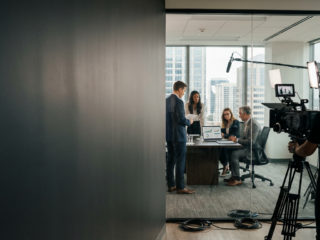
Visual Reference: Creating an un-stealable sensory experience. AI cannot summarize the emotional resonance of cinematic pacing and bespoke sound design.
Chapter 4: The “Dwell Time” Multiplier Strategy
While GEO is the future, traditional search algorithms still play a massive role in your traffic. And right now, the single most important metric for keeping your website ranking high on Google is Dwell Time.
What is Dwell Time?
Dwell time is the amount of time a user spends on your webpage before hitting the “back” button to return to the search results. If a user clicks your link, reads for 5 seconds, and leaves, Google registers a “short click” or high “bounce rate.” This tells the algorithm that your page did not satisfy the user’s intent, and your rankings will plummet.
The Video Multiplier Effect
Text is easily skimmed. The average reader scans a webpage in an “F-pattern,” looking for bold words, and leaves in under 15 seconds. However, if you place a high-quality, auto-playing (silent) cinematic video at the top of your landing page—above the fold—you instantly interrupt that scrolling behavior.
When a visitor clicks “play” on a beautifully produced 90-second brand film, your Dwell Time instantly skyrockets. Industry data for 2026 shows that pages with embedded professional video have, on average, a 260% longer Dwell Time than text-only pages. This massive surge in user engagement sends a powerful, undeniable signal to Google and AI engines: “This page is highly valuable. Rank it higher.” By investing in a cinematic video, you are effectively buying search engine dominance.
Chapter 5: Technical Video GEO: The 2026 Developer Playbook
Creating a breathtaking video is only 50% of the battle. If the AI engines cannot “read” the data surrounding the video, it might as well not exist. LLMs do not have eyes; they parse code. To dominate Generative Engine Optimization, your web development team must implement rigorous technical standards.
1. VideoObject Schema Markup (JSON-LD)
Schema markup is the native language of AI. It is invisible code that tells the engine exactly what your content is. Every video on your website must be wrapped in `VideoObject` schema. This code must explicitly declare the video’s title, a robust keyword-rich description, the upload date, the duration, and a high-resolution thumbnail URL. Without this, AI models like Gemini or Claude will not index the video as an authoritative asset.
2. Deep-Sync Transcripts
LLMs feast on text. To feed the AI, you must provide a 100% accurate, human-verified transcript directly below your embedded video. Do not rely on auto-captions. By placing the transcript on the page, you are feeding the LLM the exact keywords, entities, and “Information Gain” contained within your script, forcing the AI to associate your text insights with the visual authority of the video.
3. Entity Anchoring and Contextual Surroundings
Never place a video on a blank page. The text surrounding the video matters immensely to GEO. You must anchor the video with “Entities.” If your video is about B2B SaaS solutions, the surrounding text should naturally mention related entities (e.g., cloud infrastructure, data compliance, Irvine tech sector, SOC2 certification). This builds a “Knowledge Graph” around your video, proving to the AI that your content is deeply rooted in industry expertise.
Chapter 6: Cinematic Fidelity as a GEO Trust Signal
A common misconception is that AI cannot tell the difference between a cheap iPhone video and a $50,000 cinema-camera production. This is categorically false. AI models analyze bitrates, pixel density, audio spectrums, and user engagement metrics to determine content quality.
The Penalty for Cheap Content
If you use cheap AI-generated avatars or low-res stock footage, users will bounce quickly. The AI tracks this rapid abandonment. Furthermore, Google’s “Helpful Content System” is explicitly designed to identify and demote “unoriginal, low-quality content.” Generative video tools often produce artifacts and homogenization that trigger these quality filters.
The 7 Hills Advantage: High-End Fidelity
Cinematic fidelity is a trust signal not just to humans, but to the machines that watch humans. When we produce a video using ARRI or RED cameras, professionally graded color science, and pristine sound design, the viewer stays engaged. They watch the video to completion. They share the link. These behavioral metrics are recorded by Chrome, Android, and YouTube, feeding back into the LLM databases. High-end production creates a positive feedback loop of algorithmic trust.
Visual Reference: High-fidelity production acts as an un-fakeable trust signal. AI engines monitor user engagement with premium visuals to determine brand authority.
Chapter 7: The “Answer Engine” Flywheel (YouTube + Website)
To truly dominate GEO in 2026, you cannot host your video in only one place. You must utilize the “Answer Engine Flywheel.” This strategy involves leveraging YouTube (the world’s second-largest search engine, owned by Google) and your proprietary website simultaneously.
Why YouTube is Crucial for LLMs
Google’s AI Overviews directly pull video snippets from YouTube to answer user queries. If a user asks, “How does 7 Hills Productions light a corporate interview?”, Google SGE will likely skip text articles and present a YouTube video perfectly cued up to the exact timestamp where that topic is discussed. To capture this traffic, your YouTube uploads must utilize Key Moments (Chapters), rich descriptions, and targeted tags.
The Walled Garden: Your Website Embed
However, YouTube is designed to keep users on YouTube. Therefore, your flagship brand films and high-converting promo videos must be hosted via premium, ad-free players (like Vimeo) and embedded directly on your landing pages. This ensures that when the AI does send traffic your way, the user remains trapped in your “Walled Garden,” free from competitor ads, allowing you to guide them seamlessly into your sales funnel.
Chapter 8: The 7 Hills Framework for Search Dominance
At 7 Hills Productions, we do not just point cameras and shoot. We architect video assets specifically designed to dominate the modern search landscape. Based in Southern California, we help brands across Irvine, Los Angeles, and globally to build their visual moat. Our framework guarantees both emotional resonance and algorithmic compliance.
- Phase 1: GEO Discovery. Before writing a script, we analyze the AI search landscape of your industry. What questions are Perplexity and SGE answering? We script your video to explicitly answer those queries visually and audibly.
- Phase 2: Cinematic Execution. We deploy top-tier cinema cameras, elite lighting crews, and Hollywood-trained directors to ensure the visual fidelity sends massive trust signals to your audience, ensuring maximum Dwell Time.
- Phase 3: Omnichannel Asset Delivery. We deliver the master 16:9 cinematic film for your website, alongside perfectly formatted 9:16 vertical micro-cuts for YouTube Shorts and LinkedIn, ensuring you saturate all nodes of the AI knowledge graph.
Visual Reference: The culmination of the 7 Hills Framework. A masterfully executed brand asset designed to dominate both human emotion and AI search visibility.
Chapter 9: Future-Proofing Your Marketing Budget
The definition of marketing insanity in 2026 is continuing to pour thousands of dollars a month into generic SEO blog writers, hoping to rank on page one of a search engine that actively wants to steal your clicks. Text is commoditized. It is infinite, cheap, and easily synthesized.
Marketing budgets must shift to the un-synthesizable. By reallocating your SEO budget into premium, high-fidelity video production, you are not just buying a marketing asset; you are buying an insurance policy against AI. You are creating a piece of intellectual property that establishes un-fakeable human authority, commands attention, skyrockets your website’s dwell time, and forces Generative Engines to recognize your brand as the definitive leader in your space.
Frequently Asked Questions About Video GEO
Is traditional SEO completely dead?
No, but it has fundamentally changed. Informational queries (“What is X?”) are now answered directly by AI on the search page (zero-click). Transactional and deep-dive queries (“Who is the best X in Irvine?”) still drive clicks, but only to sites that prove massive authority. Video is the fastest way to prove that authority.
Do I need to host my videos on YouTube or Vimeo for GEO?
Both, but strategically. Use Vimeo (or Wistia) for the main video on your website’s landing pages to keep users trapped in your funnel and boost your site’s Dwell Time. Upload the exact same video to YouTube (which is owned by Google) to capture native video search traffic and feed the SGE algorithms.
How long does it take for video to impact my search rankings?
While traditional text SEO can take 3 to 6 months to “sandbox” and rank, the addition of a high-retention video to a landing page can positively impact your Dwell Time metrics almost immediately. Many clients see a stabilization or recovery of AI-lost traffic within 30 to 60 days of implementing a cinematic video strategy.