

Video Production for MedTech, Biotech, Hospitals, and Healthcare Brands
In healthcare, clinical data alone rarely builds trust, shortens sales cycles, improves recruitment, or comforts anxious patients. This guide explains how healthcare video production helps medical brands communicate complex science with clarity, empathy, compliance, and authority.
Executive Summary
Healthcare marketing carries more pressure than almost any other industry. Whether you are a biotech company preparing for investor conversations, a medical device company launching a new system, a hospital network recruiting physicians, or a healthcare brand trying to educate patients, trust is the real decision driver. Premium healthcare video production helps close the gap between complex medical information and human understanding.
This guide explains how healthcare videos support patient trust, physician recruitment, MedTech sales, biotech fundraising, internal training, clinical education, and stronger digital authority. It also shows how a thoughtful video strategy can create multiple content assets from one coordinated production day, making your investment more efficient across marketing, communications, recruiting, education, and sales.
Clinical Asset: Establishing Trust & Visual Authority
Establishing institutional authority, care quality, and patient empathy through premium cinematic framing.
Index of Contents
02. Visualizing the Invisible: MedTech & Biotech
03. Securing Capital: Fundraising Video Systems
04. The Strategic Healthcare Video Map
05. Medical SEO & Digital Authority Mapping
06. Internal Training, SOPs & Compliance
07. Budgeting Formulas & Content Libraries
08. Specialized Healthcare Video Formats
09. Comprehensive Service Directory
10. Frequently Asked Questions
The Empathy Engine: Rebuilding Patient and Provider Trust
Healthcare relies on verified parameters of trust. A hospital board reviewing an expensive technological acquisition, a clinician evaluating an intake workflow, or a patient choosing a specialty surgical center all demand more than basic statistical data. They require confidence. They must verify that the personnel controlling the hardware, therapy, or facility possess unmatched technical competence and profound human empathy.
This is why high-end media capture functions as a critical business asset. High-fidelity video conveys non-verbal authority, physical clinic scales, provider posture, and unscripted patient sentiment in a way that dry data blocks cannot. It converts broad marketing claims into undeniable proof lines.
For patient validation and provider alignments, high-quality testimonial and interview video production is standard protocol. A patient detailing an oncology recovery or bariatric milestone in their own words commands immediate credibility. This human layer reinforces your public image, naturally feeding your primary corporate assets, including corporate video production, brand video development, and tactical promotional campaigns.
Visualizing the Invisible: MedTech, Biotech, and Mechanism of Action
The primary friction point in advanced medical business development is complexity. When an institutional procurement panel, neurosurgeon, or investor cannot easily conceptualize the exact utility of an asset, they default to legacy alternatives. This challenge is pervasive across robotic configurations, diagnostic platforms, biologic therapies, and digital health software deployments.
Premium product video production materializes device ergonomics, software interface parameters, and on-site clinical tracking directly for evaluators. For biotech and pharmaceutical firms where target cellular mechanisms or receptor interactions are invisible, high-end explainer video production and custom medical animation render scientific complexity immediately clear, mitigating perceived risk and removing barriers to conversion.
Securing Capital: Biotech and MedTech Fundraising Videos
Life science and medical device investors prioritize leadership composure, facility scale, and commercial viability over raw pitch-deck metrics. A dedicated investor film materializes your laboratory environments, manufacturing standards, and clinical compliance infrastructure, demonstrating total operational readiness to venture panels.
For complete strategies on engineering capital campaigns, explore our framework on Fundraising and Investor Pitch Videos.
Clinical Reference: Investor & Procurement Staging
Proving operational reality, laboratory footprints, and regulatory authority to financial networks.
The Strategic Healthcare Video Map
A mature corporate layout treats media as a mapped, full-funnel content network. Different medical stakeholders hold highly divergent inquiries across their conversion journeys. Patients, clinical providers, procurement analysis boards, and capital partners require distinct visual formatting parameters:
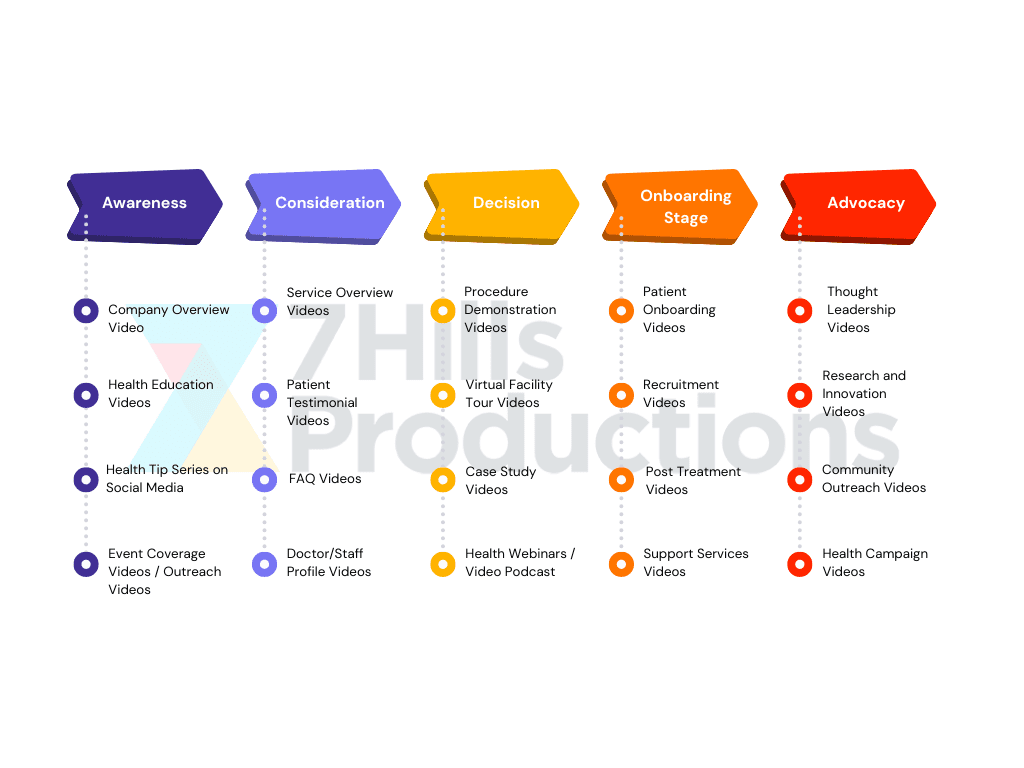
Strategic Blueprint: Mapping targeted healthcare media configurations directly to patient, provider, and institutional buying cycles.
This architectural map ensures peak operational alignment across marketing, professional communications, and medical staffing tracks. It allows distinct visual categories—including full keynotes captured via event video production or specialized medical discussion panels structured through our video podcast production channels—to lock perfectly into your funnel layout.
Medical SEO, Search Visibility, and Digital Authority
Enterprise healthcare visibility patterns are undergoing an absolute structural evolution. Consumers, clinical directors, and business evaluators increasingly query AI Answer Engines and localized semantic grids to determine regional authority. In this environment, raw keyword optimization is obsolete.
High-retention visual assets embedded cleanly inside technical service page architectures extend page dwell metrics dramatically. This coordinates a flawless Video GEO strategy, forcing indexing models to rank your properties as the preeminent clinical entity in your market, driving massive acquisition velocity across primary service areas like Irvine, Los Angeles, and San Diego.
Internal Alignment, Training, SOPs, and Compliance Communication
Healthcare video functions as an absolute risk-mitigation tool inside large systems, medical manufacturers, and laboratories. Standardizing complex operating procedures, onboarding metrics, provider updates, and compliance requirements via an integrated education video production framework significantly reduces staff error rates and ensures strict protocol fidelity across multi-site networks.
Clinical Reference: Compliance Staging & Clinical SOPs
Standardizing laboratory training, compliance communications, and multi-site workflows visually.
Architecting the Budget: Better ROI Through Content Libraries
A frequent miscalculation in clinical procurement is budgeting for isolated media assets sequentially. High-performing facilities deploy Modular Content Design, coordinating a single dedicated shoot schedule to capture an entire, versatile visual inventory. This method drastically lowers the cost-per-asset ratio across your organizational departments.
Review our specific financial planning frameworks below to benchmark your capital structures. For exhaustive pricing calculations, reference our comprehensive Healthcare Video Production Cost Directory.
| Medical Asset Package | Primary Distribution Endpoints | Primary Operational Utility | Capital Allocation Range |
|---|---|---|---|
| Flagship Brand Documentaries | Homepages / Investor Presentations | Establishes elite market positioning, institutional weight, and vision scale. | $5,000 – $15,000+ |
| Patient Success Case Studies | Service Gateways / YouTube Channels | Provides verifiable social proof points and systematically limits pre-op anxiety. | Starts at $3,500 |
| Clinical Batch Day Engine | LinkedIn Feed / Shorts / Instagram | Sustains high-frequency condition awareness metrics via provider soundbites. | $4,500 – $8,500 (Batch) |
| Internal SOP & Compliance Tools | Intranet / Provider Portals / HR Portal | Standardizes complex laboratory workflows and aligns multi-site execution. | Custom Retainers |
Partnering with a full-service production group ensures you optimize your overarching Video Marketing Budget, mapping every cinematography hour into durable, reusable digital capital assets.
Healthcare Video Types That Consistently Perform
A mature corporate layout demands distinct visual asset configurations working in parallel. For core user credibility, rely on documentary case records. For Biotech and MedTech organizations, highly technical explainer content and focused product validation videos are non-negotiable. For healthcare spaces requiring high-impact clinical trailers, access premium brand anthems to anchor your web infrastructure.
Comprehensive Service Directory & Resource Nodes
Explore individual structural specialties across our complete, integrated visual productions network:
Frequently Asked Questions
How do you protect HIPAA constraints and patient privacy protocols during clinical filming?
Patient data compliance is integrated directly into pre-production mechanics. Our workflow incorporates specialized medical release forms, explicit frame composition guidelines, and comprehensive environment auditing on set to ensure no protected health information (PHI) surfaces on charts, monitors, or background fields.
Can high-fidelity video shorten B2B hospital procurement and committee selection timelines?
Yes. Enterprise hospital boards comprise diverse stakeholders: clinicians evaluate procedural accuracy, while financial panels assess risk and return parameters. A professional media ecosystem speaks to all layers concurrently, presenting unarguable proof of clinical superiority and device utility to bypass committee friction blocks.
What medical fields and enterprise organizations optimize best using cinema assets?
Large hospital groups, specialized surgery clinics, surgical device developers, therapeutic biotech labs, remote health networks, and research centers realize massive positioning leverage from dedicated video content setups.
Can a single coordinated production day yield a complete healthcare asset library?
Absolutely, via rigorous pre-visualization. A single structured capture window outputs a master identity overview alongside modular user case studies, short condition awareness cuts, staff compliance assets, and clean static photography packages.
How does advanced visual content improve visibility across AI search engine summaries?
AI contextual architectures evaluate domain dwell metrics and authority layers to deliver local definitions. Embedding rich, professional video keeps users anchored to your layout, executing an elite Video GEO blueprint that establishes your facility as the preeminent clinical resource.
Should clinical recruitment media be deployed solely inside the careers gateway?
No. Distribute provider acquisition segments natively across networks like LinkedIn and targeted professional channels. Sourcing high-end specialists requires catching passive interest in their feeds long before they browse job forms manually.
What makes a healthcare video campaign perform optimally over time?
Sustained performance demands a clear baseline balance: explicit technical message delivery wrapped inside genuine emotional resonance. Visual assets must address specific user journey problems while projecting an uncompromised image of institutional polish.
Prescribe Cinematic Authority
Healthcare communication demands absolute precision, clarity, compliance, and trust. Your visual presence must match the pristine quality of your care, your science, and your leadership. To see our framework in application, evaluate our comprehensive video production portfolio.